
Tuesday, February 28, 2012
The Case of the Missing Cajones

Doobie Jr. went to the vet to have his cat-manhood sniped. When I called later for a status I was told he didn't have his teabag to begin with. Good, I thought, someone did this for me before he went wild on the refuge. This will save me a couple of hundred bucks. When I arrived to retrieve him the vet said there appeared to be no signs of a neutering yet he had a penis. As yet Doobie has not exhibited the signs of a cat on raging hormones although he does give Motorhead grief once in a while. There's the possibility the testicles are inside him and that would entail cutting him open to dig them out which is like spading and more expensive. I'm going to wait 2 more months then have a testosterone test preformed to see what's going on. Figures.


Sunday, February 26, 2012
Prescribe Burn - San Bernard National Wildlife Refuge


Spring Yard


There wasn’t a winter this year; the coldest temperature was 35 degrees. Most of my trees dropped their leaves but the Texas Wild Olive (Cordia boissieri) retained its foliage and is now in the process of replacing it with new leaves. In a typical winter that tree would be leafless. The tropical sage (Salvia coccinea) did not die back, thus flowering with the spiderworts in late January. Other plants are emerging early – turk’s caps and wafer ash but the standards are on time – Red Buckeye (Aesculus pavia), Hairy Phacelia (Phacelia hirsute) and Drummond’s Hedge Nettle (Stachy drummondii). I assume the Coneflower (Echinacea angustifolia) and White Honeysuckle (Lonicera albiflora) bloom much later in the Texas Panhandle where I collected them. New flowering additions are the Mexican Plum (Prunus mexicana) and Laurel Cherry (Prunus caroliniana). Neither have an additional tree to cross pollinate at this time so I doubt fruit will appear. Bedstraw (Gallium aparine) is as persistent as ever but an annual and if I can rake the majority of it I won’t have such a nuisance next year. Same goes for Carolina Geranium (Geranium carolinianum). Coral Bean (Erythrina herbacea), Flame Acathus (Anisacanthus quadrifidus) and Beauty Berry (Callicarpa Americana) are just emerging. My lone pecan (Carya illinoiensis) and Button Bush (Cephalanthus occidentalis) won’t have foliage until late March or later.
I put out a bird feeder this “winter”. There’s a pair of resident Eastern Chickadees that get to it between the mass feedings of English Sparrows. Lately I’ve seen a flicker that is not intimidated by the mobbing of grackles. For a while I would fill the feeder every 3 days but the grackles clean it out in a day. My intent for the coral honeysuckles (Lonicera semprevirens) and Cross Vine (Bignonia capreolata) is have them surround a section of the backyard with dense foliage of unobservable privacy and a multitude of flowering for migrating and resident hummingbirds.
Wednesday, January 11, 2012
Hmmm, guess they had to sex up the new version
Ezekiel 23:19-20 - King James Version
Yet she
multiplied her whoredoms, in calling to remembrance the days of her
youth, wherein she had played the harlot in the land of Egypt.
For she doted upon their paramours, whose flesh is as the flesh of asses, and whose issue is like the issue of horses.
Ezekiel 23:19-20 - New International Version
Yet she became more and more promiscuous as she recalled the days of her youth, when she was a prostitute in Egypt. There she lusted after her lovers, whose genitals were like those of donkeys and whose emission was like that of horses.
Wednesday, October 19, 2011
Creepy Crawly
The
Golden Orb Weaver (Nephila clavipes, Lat. clavis — "lock pick" + pedis —
"foot") is a species of golden orb-web spider. It
lives in the warmer regions of the Americas. The large size and bright colours of the species
make it distinctive. The female is much larger than the male.
It has an abdomen
whose dorsal (upper) surface is marked with a multitude of white or pale yellow
spots on a gold background. This specimen has seven pairs of somewhat
larger white spots down the median of the dorsal abdomen, with an interesting
arrangement of ancillary spots, some white, others black.
The Conspicuous tufts of black hair adorn the first, second, and fourth legs on each side of the body. The tufts are positioned at the distal ends of the femur and tibia of each of these legs. While all spiders have at least two claws on the tips of their tarsi (the last segments on the legs) most orb-weavers--including this species--have three claws, consisting of the paired claws and an unpaired, median claw.
In
the United States, it ranges throughout the coastal southeast and
inland, from North Carolina to Texas.
Its distribution in many regions seems localized, and it may be completely
absent (or just hard to find) over wide areas. Conversely, in some arboreal or
swampy nooks, adults and their webs can be found in large concentrations,
especially near the coast. Golden orb-weavers are especially numerous in the
time after summer and before fall in the south-eastern and southern U.S. This
species is widespread — and often common — in large parts of Central America and warmer regions of South America.
The web of a mature female can reach one meter in width, the
yellow threads appearing as a rich gold in sunlight. Males come into the
female's web for copulating. After mating the female spins an egg sac on a
tree, laying hundreds of eggs in one sac. While it is venomous to humans, it will only bite if pinched, and if doing
so, the bite is usually relatively harmless and only leads to slight redness
and localized pain.
Source
– Wikipedia, http://www.bugsinthenews.com/spiders_in_the_fern_bluff_mud.htm
Sunday, September 25, 2011
Doobie Jr.

A year to the month that Doobie passed on I was given the
opportunity to care for another cat.
“Doobie Jr.” was hanging around a trailer near the Brazoria NWR and fed
daily by a summer intern. Since she was
leaving town and heard from the refuge biologist that I wanted a black cat, she
contacted me about the adoption. I
picked Doobie Jr. up the next morning; a mile from where I found Doobie Sr. 6
years ago. I don’t think it's far-fetched to
believe that Doobie Jr. came from the same lineage. He has the same body type, is congenial and
“gurgles” when he’s about to jump on the bed to sleep with me. He is growing accustomed to his siblings but
will still hiss if they get too close.
After a day or two I could leave him outside all night and I’m sure he
has marked out the boundaries of his territory.
He’s about 6 months old.

Sunday, September 18, 2011
The Bastrop Complex Fire
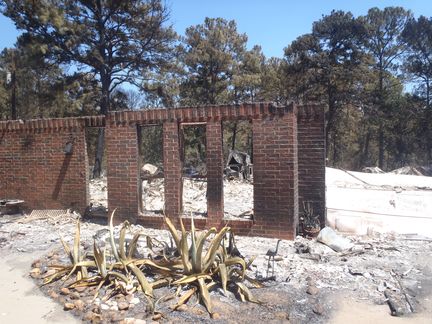
The Bastrop Complex fire consumed over 1300 homes and 34,000 acres in a swath south of Bastrop Texas. Moving from the east, it jumped the 4-lane state highway 71 and continued into a subdivision. There was no logic in the way houses were engulfed by flames. Fanned by 40+ mile winds the fire would destroy one home yet leave its neighbor intact. Local firemen told us this was going to happen but their advise to thin heavy brush in the neighborhoods was ignored. We could only speculate why houses burned that had brick walls and metal roofs. Perhaps the super heated air and firebrands entered through side vents of the attic?
We got the call but like many of the hundreds of firefighters mobilized were too late to help other than mop up small fires or chainsaw trees that were a falling hazard. Residents continuously thanked us for saving their homes but we had little to do with it. Still, it was a comfort for them knowing we were there. Three days later the returning residents sifted through ashes for anything to connect to their past.



Coworkers Steve Foster (sawyer) and Matt Callahan (swamper). Matt is hammering wedges into the cuts made by Steve. These wedges direct the fall of the tree as they are further hammered in. This tree was a falling hazard because most of its base was burned away. Clearing away brush from the perimeter allows for a quick exit.
We got the call but like many of the hundreds of firefighters mobilized were too late to help other than mop up small fires or chainsaw trees that were a falling hazard. Residents continuously thanked us for saving their homes but we had little to do with it. Still, it was a comfort for them knowing we were there. Three days later the returning residents sifted through ashes for anything to connect to their past.
Saturday, September 03, 2011
This months' project


Background: the "Austin's Woods Conservation Plan" led by the U.S. Fish and Wildlife Service is a mandate to preserve the bottomland hardwood forests south of Houston known as the Columbia Bottomlands which spans the Colorado, San Bernard, and Brazos River floodplains. It is a critical stopover and staging habitat for Nearctic-Neotropical migratory landbirds.
Despite temperatures at or above 100 degrees the field work is better than rotting away in an air conditioned office. I was asked to continue a project by the United States Geological Service which entailed correlating habitat change with an increase or decrease of migrating neotropical birds. Originally accomplished by crews I was left on my own to conduct this monitoring of 41 sites in the bottomland hardwood forests of my Complex. Each site has 30 variables to measure to include tree diameter, woody species height, snag diameter, canopy gap, plant species inventory, presence of an oxbow or bayou, canopy cover, size of woody debris, herbaceous cover and wet or dry litter. All within 3 meters along a 50m measuring tape. Laying out the tape is no walk in the park with more often than not a lot of bushwhacking, crawling, neck raked or head gouged by braches and briar. I learned my lesson after the first day to spray my feet and calves with bug repellent less I continue to scratch from chigger infestation. A yellow jacket stung the back of my arm but rarely swell up from the sting of this species of wasp.

American Elm (Ulmus americana)
50 ft+ tall

Buttresses help stabilize swallow-rooting trees

Box elder maple (Acer negundo), left, is similar in appearance to poison ivy (Toxicodendra radicans).

Virginia creeper (Parthenocissus quinquefolia) is in the grape family but the fruit is inedible for humans.

Grape vines (Vitis spp.) can live beyond 100 years.

Old growth grape vine with pencil for scale.

Green Brier (Smilax rotundifolia)
 Carolina Moonseed (Cocculus carolinus) is a common understory vine. In this picture the vine is entwining so hard that the tree is starting to grow around it. Moonseed berries are red and eaten by birds but are toxic to humans.

Turks' Cap Trumpet Creeper (Campsis radicans) is (Malvaviscus arboreus) maximizes blooming during the southern migration of hummingbirds

Trumpet Creeper (Campsis radicans) is also a favorite plant of hummingbirds

Sabal Palm (Sabal minor) is the most common plant encountered thus far.
Subscribe to:
Posts (Atom)